
Women Composers and Musicians, from the Middle Ages to the Present Day
A selection of three publications devoted to female musicians from three different eras.




While Hildegard von Bingen and her music are famous today, what about the other female musicians of the Middle Ages in Western Europe? Musicologist Anne Ibos-Augé sheds light on a largely overlooked chapter of history, revealing many surprises. For example, we find a female minstrel who was better paid than her husband, even though they practiced the same profession: pay was not determined by gender, but by talent or the enjoyment of the audience. In fact, according to the regulations governing minstrels in Paris, female minstrels and jugglers were on equal footing with their male counterparts. Indeed, after the early feudal period—which yields few records and in which women’s roles were marginalized—the emergence of chivalry and courtly love in the 12th century, along with the growing importance of cities, allowed for a relative evolution in social mores. Few musical scores are attributed to female composers—it is quite possible that a significant number of anonymous works were written by women—and only a few names have survived, particularly those of trobairitz and trouveresses.
The book is divided into ten chapters, each focusing on a particular way of life for female musicians of the time: nuns, who in some convents had their own specific chants (and thus likely composed them themselves), Beguines and mystics, copyists (generally nuns in their scriptoria), lyric poets writing in the Langue d’oc and Langue d’oïl—as already mentioned—who were rarer elsewhere (at least according to current knowledge), patrons and dedicatees, and finally, fictional characters, whether the shepherdess Marion, female musicians imagined in literature (including Yseut), or Music as an allegory. Much interesting research and many discoveries are to be hoped for in this hitherto little-explored field.
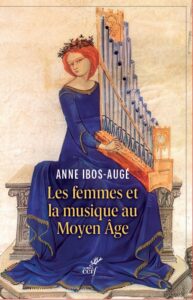
Anne Ibos-Augé: Women and Music in the Middle Ages, 288 pp., €22.00, Éditions du Cerf 2025, ISBN 9782204160063
Caroline Charrière (1960–2018)
The papers presented at a one-day symposium held in October 2023 at the University of Strasbourg—entirely dedicated to Caroline Charrière (apparently a first for a Swiss composer)—have been compiled into a volume published by Editions Slatkine. Initially drawn to a form of post-Romanticism that oscillated between tonality and modality, she gradually made greater use of chromaticism and dissonance, sound effects, and contemporary performance techniques, though her music remained accessible to the general public. Her secular choral works, the social and musical context of brass bands and wind ensembles—where she began her career as a flutist—and the press reception of her work are among the topics covered. Her use of the harp—one of her favorite instruments—is examined by Consuelo Salvadori, herself a harpist: whether evoking wondrous landscapes, symbolizing femininity, or being associated with sacred music, the range of expressions employed proves to be rich.
Writing an opera remains the unfulfilled dream of the woman from Fribourg who passed away too soon; work on The Three Sighs which was delayed and complicated by, among other things, insufficient funding. This project—of which only one scene was ever produced—bears witness to her feminist commitment and her critical stance toward the operatic tradition of portraying women as victims incapable of controlling their own destinies. Delphine Vincent describes its genesis and dramaturgical choices. Beat Föllmi, for his part, examines the oratorio’s score The Book of Job, and in particular on her libretto, in which the choice of verses reveals the composer’s personal interpretation. As the author of a monograph on Caroline Charrière, Irène Minder-Jeanneret reflects on the purpose of a biography, as well as on the impossibility of achieving complete objectivity—for example, due to the risk of projecting one’s own thoughts and feelings onto the subject.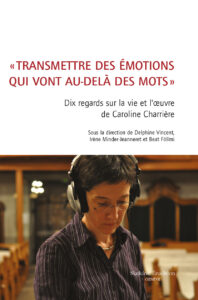
Conveying Emotions That Go Beyond Words: Ten Perspectives on the Life and Work of Caroline Charrière. Edited by Delphine Vincent, Irène Minder-Jeanneret, and Beat Föllmi. 178 pp., CHF 40. Slatkine Publishers, Geneva 2025, ISBN 9782051029612
Rita Strohl (1865–1941)
Just a decade ago, the name Rita Strohl was virtually unknown. Several recordings of her intense Grand Dramatic Sonata «Titus and Bérénice» for cello and piano, followed by a three-disc set on the label The Treasure Chest, sparked admiration and interest in this forgotten artist, whose sweeping melodic phrases were imbued with a powerful vitality, capable of constructing vast musical structures, such as her Symphony of the Forest, as much as carving miniatures. Fiercely independent, she shunned Parisian salons; her works were never published and survived only thanks to the dedication of a few members of her family. With her second husband, the pianist, painter, and master glassmaker Richard Burgsthal, the Breton composer secured the funds to build her own theater in order to stage her operas, which were marked by Wagnerian influences and Celtic references (The Legend of Hu-Gadarn, an opera with a total running time of ten hours, spread over five days) and a mysticism akin to theosophy and Hinduism. Once the hall was completed, however, the venture came to an abrupt end, and the inaugural concert of this “little Bayreuth” in 1923 was never repeated.
Rita Strohl’s relative obscurity, along with the destruction of nearly all her letters and photographs—some of which were lost during the bombing of the city of Lorient—makes writing her biography a difficult task, forcing Agnès Boucher to undertake a true detective’s work in period publications and family archives. The first book dedicated to this composer of such endearing works, was not written by a musicologist or a musician—and consequently contains no analysis of her scores—but by a writer who enjoys using her engaging and precise prose to shed light on overlooked women, in order to help readers better appreciate them.
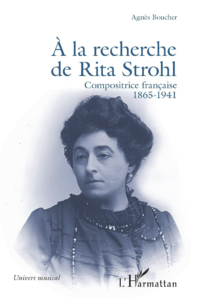
Agnès Boucher: In Search of Rita Strohl, French Composer 1865–1941. 300 pp., €30.00. Éditions L’Harmattan, Paris, 2026, ISBN 978-2-336-60656