
A Perfect Imbalance
There aren’t even a thousand places in the city of Geneva dedicated to building, repairing, selling, and everything else related to guitars. Just a few stores and luthiers—you can count them on one hand. But when it comes to classical guitars, the go-to place is Jacques Vincenti’s workshop.


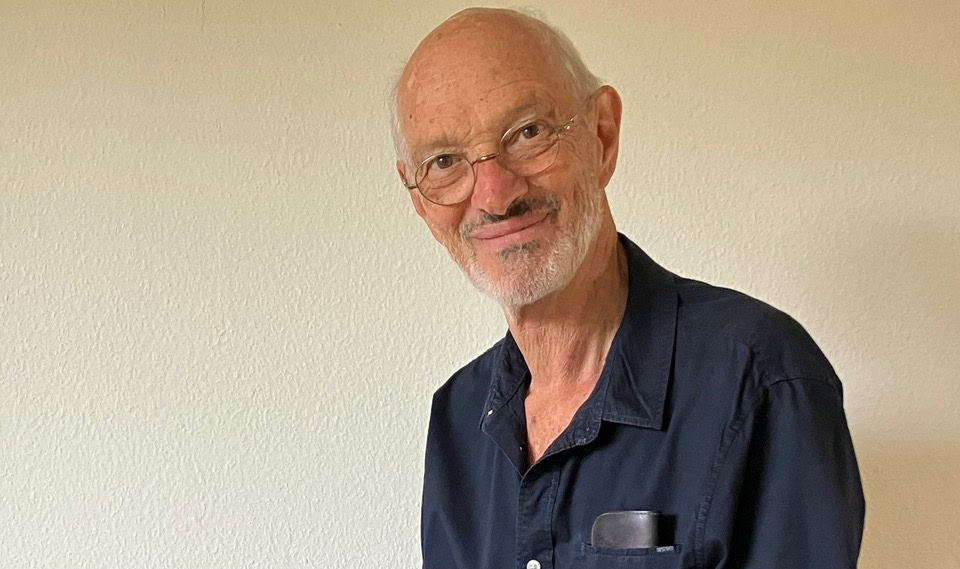
He opened his store in his hometown in 1979. «I’d seen a flyer: on one side was an English musical instrument store, and on the other was a luthier’s workshop in Spain. I thought to myself that I needed to bring the two together into a single, unified concept, and that’s what I tried to create,» he explains. After spending some time in England, he worked in several Spanish workshops. He then opened his own workshop in Geneva, focusing on the multifaceted nature of the business: selling and assisting customers, and, from time to time, building, restoring, and offering advice.
Over the years, he has built a loyal following among local conservatories and schools, as well as a host of professionals from French-speaking Switzerland and around the world. The workshop is no longer just a center for guitar making, but also the headquarters of an association that organizes the famous “Jeudis de la guitare” events, and the heart of the guitar community for an entire region.
«A true luthier makes between ten and fifteen instruments a year; I’m one of them—when I can manage it: there are, in all, about forty to my name. I’ve been very lucky because people have brought me some truly beautiful guitars to restore,» he says, with his characteristic modesty. «The curiosity I’ve applied to these instruments has opened doors for me and taught me a great deal. I always collaborate with the other people in my workshop: Mariann Burri and Guillaume Dayer—the latter having taken over for Léonard Plattner. It’s essential to be able to exchange ideas with other professionals, because we share our thoughts and pool our expertise. There’s an ethical standard to uphold when working on instruments with a history: tackling the work as a team helps ensure we make the right choices.»
Restoration has become one of this workshop’s strengths, in part thanks to the passion Jacques has developed for a particular school of thought: early 20th-century Catalan violin making. This is evident in the book he authored, which has just been published by Camino Verde, featuring magnificent photographs by Alberto Martinez: Enrique García, a builder from Barcelona.
«I first discovered Francisco Simplicio’s guitars,» he says, «which showcased exceptional craftsmanship and artistry. He was a student of Enrique García, and I was curious to find out who García was. I found one of his guitars, and it completely won me over. A well-balanced instrument is rarely interesting, and this García had, to my taste, a perfect imbalance: full bass, subtle mids, and singing trebles that were still restrained.»
Passion for Work
This luthier’s passion for his craft becomes a subject of study, and Vincenti realizes that some of these guitars are built according to a design based on the golden ratio and the Fibonacci sequence, with nods to Catalan Romanesque architecture. There are also correspondences between the vibrating length of the strings at specific notes and the dimensions of the soundbox’s various parts. «Then there’s something visual and tactile about them: these are guitars with beautiful proportions—open, elegant, and possessing a certain softness. »What I feel is that this softness, this tactile pleasure, is conveyed to the performer,« he argues. »Not to mention the objective qualities of the sound: a very broad and distinctive range of nuances, which changes depending on where you play. This makes them very imperfect instruments if the criteria are performance, stability, etc., but it’s a sublime imperfection—the exact opposite of the coldness of a digital instrument.”
It emerged as a model that, as a luthier, he wanted to follow. «With all the guitars I’ve seen pass through my workshop, I can say that there are many different schools of lutherie, and that some of them have achieved outstanding results. It can vary greatly. What I see with García is that he had a precise plan, a method to stick to, and with that, he knew how to achieve an incredible result. That aligns with my own approach to work—a precise ideal of sound for which no compromises should be made.»