
A (music) school that makes people happy
Developing music schools and reflecting on their future: this will be the central theme of the Forum on Music Education (FFM) on January 22 and 23, 2027, in Baden. Speaker Jörg Berger, a school director and author, will explain why he believes in bold visions and what the future might hold for us.


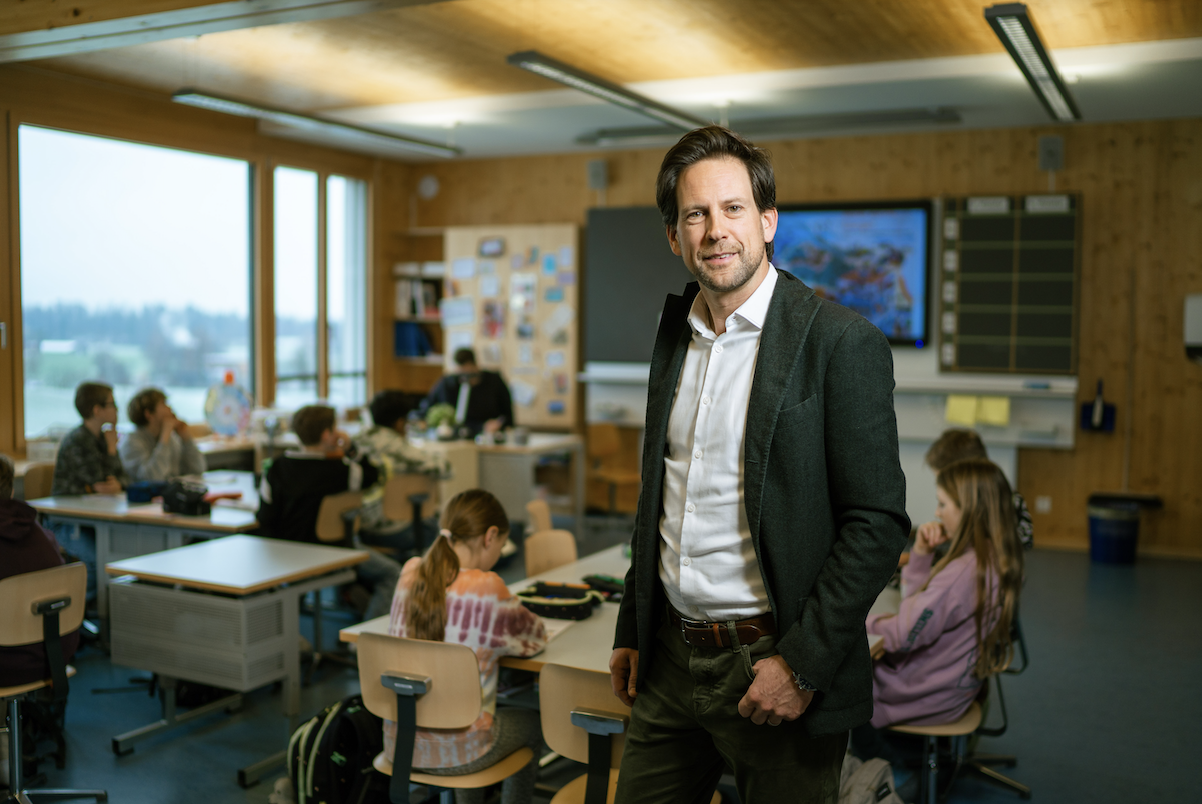
Jörg Berger, your talk is titled «A Vision for the School of the Future.» What can the FFM audience expect?
We'll discuss what visions for the future are—where they come from and how they're formulated. But we'll also touch on future studies in general. Since we are so often confronted with news that upsets us and sometimes frightens us, it might be all the more important to focus on issues related to the future. Because I believe that this can inspire a great deal of hope.
What does it take for a person to develop visions that inspire hope?
Anyone who works on visions discovers very deep inner values; it’s like a treasure lying dormant in the deep sea that you begin to bring to the surface. You say to yourself: Wow, that’s me! That really struck me—it’s my life story. At the same time, a vision is never carried by just one person. A vision comes to life when it touches on dreams that many people are dreaming at the same time. Hey, do you think that would be a good thing, too? Do you also think it would be beneficial for you? It can give rise to extraordinary strength. I often picture it as a mountain range. We look at the Alps; we see the first ranges of hills, then the next ones, and then, far behind—already somewhat blurred, perhaps in the twilight—the four-thousand-meter peaks, the visions. When we realize that we’re all drawn to them, we can set out on our journey. Together, we can assess whether we’re up to the task and decide whether to take the direct, steep route or a more circuitous path. Whether we’ll lead the way in a small group, or whether we’ll take everyone with us.
So, we try to move forward every day toward that vision, even if it still seems out of reach.
Yes, that’s the idea. As a group, we can then determine the framework or decision-making basis we need—which could be, for example, a charter or an annual plan. It’s helpful to know where the long-term goal lies. We also learn to trust one another—when everyone knows the long-term goal and shares the same vision, we can more quickly figure out the necessary steps. At the same time, a clear vision can also act as a filter. So many things are presented at school—a clear vision helps us assess more effectively and quickly whether something is appropriate or not.
Can you give a specific example of this type of process?
At Knonau School, we have spent the last four years giving a great deal of thought to how we would like to support students throughout their learning journey. We’ve been asking ourselves how we can promote effective learning while issuing report cards that are fair and easy to understand. We began the process with a participatory approach and asked parents how far we could go as a school. For us, it’s important that the report card be more than just the sum of all the grades—that was a statement situated all the way at the back of the mountain range, to use the image that inspired us. We identified issues, invited people, visited schools, and assessed what works best for us. And this process continues to this day. The guidelines we have developed state, among other things, that: Students at the Knonau School learn to determine for themselves when to assess their learning. Or: We apply a wide range of formative assessment tools on a large scale.
Where does your interest in training come from?
That’s a great question. Even as a child, I was very curious and enjoyed meeting new people, which has been a great asset to me as a teacher. And I also quickly realized how much I loved being a school principal. I became a principal at age 26, right when the position had just been created—at least in Switzerland (laughs). Later, I also attended the Zurich University of Teacher Education and was able to contribute to the development of the CAS digital Leadership in Education.
You co-authored the book *Schule 21 macht glücklich* with other education experts. What was it like for you as a child: Did school make you happy back then?
I’ve experienced both: happy and not-so-happy times in school. Then I spent five absolutely wonderful years at teacher’s college—I couldn’t have imagined anything better. I consider it a great privilege to have discovered my passion—education—so early on, and I can only be grateful for that.
In this book, you note, for example, that students should be able to develop their own strengths. What do you mean by that?
Supporting talent should apply to everyone at school—students and staff alike. To achieve this, the school must provide a wide range of inspiring and stimulating opportunities. Students should be able to explore a wide range of experiences without being steered prematurely toward a specific path—such as, “You’re good at math, so that’s the area we’ll encourage you to pursue.” They should also have a say in how they’d like to spend their learning time.
You also place a great deal of importance on participation: parents and students should be involved in the school’s development. How might that look in practice?
We can take Sweden’s Handelsbanken as a model, for example, and flip the organizational chart so that parents and children are at the top. The next level down consists of teachers and the parent council, who do everything possible to help students succeed; followed by middle management, such as school principals and department heads, and then, at the very bottom, the authorities. This way, it quickly becomes clear that the goal is to provide as many resources as possible to the upper levels so that the children feel comfortable. To achieve this, the approach we have currently adopted at our school is to integrate the parents’ council into our steering committee. And we are exploring ways to allow children to have a voice within the steering committee without requiring them to participate in bodies composed of adults.
A chapter titled «Zurück in der Leichtigkeit» (Rediscovering Lightness) is devoted to humor in school.
That’s actually why I love being a school principal so much: seeing beaming faces because something brings them joy, because the school is full of life, because people are doing well—that’s what recharges my batteries. We can interact with a sense of humor as long as relationships are good and there’s mutual trust.
FFM 2027: Learn more and sign up