
Music lessons must be fun
The SSPM is committed to high-quality music education in Switzerland.
In order to find as nuanced an answer as possible to the complex question of what characterizes quality music education, I asked SSPM members, as experts in the field, what this meant to them.




In response to this survey, some seventy highly varied texts were received in just ten days. This wonderful abundance of responses shows just how much musical pedagogical knowledge and expertise our association brings together, and how much emphasis members place on different areas.
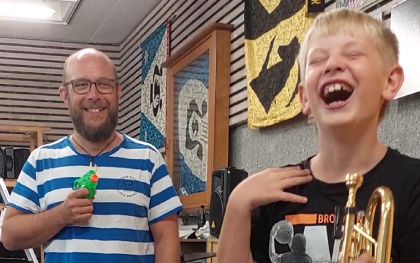
SSPM members agree that the teacher∙e must himself/herself master his/her instrument, that he/she should if possible perform regularly in public and that he/she should be familiar with subtle stylistic differences. He/she is expected to enjoy teaching. More than half the responses indicate that teaching music should be fun.
Members disagreed on whether the responsibility for good music teaching lies exclusively with the teacher∙e, to what extent students should contribute to it, how important good framework conditions set up by the music school are and whether, in the case of children, the attitude and cooperation of parents also have a decisive influence on the quality of teaching.
The qualities that different teachers∙e∙s consider particularly important depend, of course, on their own situation, depending on whether they teach school-age children in a music school, whether their class consists almost exclusively of adults, or whether they focus on early music education. Those who know only about individual lessons have other priorities than those who give group lessons and teach chamber music. And the instrument one plays also defines priorities: a pianist will attach particular importance to a good-quality, well-tuned instrument, while a singer will favour good acoustics in the classroom.
I'll try to bring together the many points of view to develop a recipe for ideal music education.
When I quote colleagues, their names appear in brackets.
Recipe for quality music education
Part 1: The music teacher
Quality music teaching requires a music teacher who is well trained∙e in his/her instrument, passionate∙e about music, his/her instrument and teaching. He/she masters his/her instrument perfectly on a technical level and is able to transmit this technique to very different students in a personalized way. He/she has a "magic box" from which he/she can always pull out tricks to playfully solve technical problems that seem very difficult. Thanks to his/her analytical ear and attentive eye, he/she detects technical problems as soon as they appear and then helps his/her pupils to overcome difficult passages. He/she has a sense of style and can convey stylistic subtleties well, allowing students to experience for themselves the accentuations, dynamics and agogics that bring them into the flow of a particular style. "A musical education that opens the ears to different musical styles allows students to discover their preferences. It's therefore important to offer as wide a musical spectrum as possible in music lessons." (Susanna Fröhlich-Baumann)
The music teacher∙e is empathetic, caring∙e, patient∙e and full∙e of humor. He/she treats his/her students as equals, always giving them the feeling that he/she respects and appreciates them, and that when he/she criticizes something, it is always the thing in question that is targeted, not the person. "She attaches great importance to her students' well-being. That's why she addresses tensions and sometimes advises a change of teacher or instrument." (Elisabeth Buess) "He/she breaks everything down into small steps so that students can experience success." (Agathe Jerie) "He/she helps the student overcome the blocks that prevent him/her from expressing the musical discourse he/she feels deep down." (Irene Abrigo) He/she encourages students to regularly step away from the score to improvise, and teaches them to listen carefully. She prepares her lessons carefully, but is able to deviate from the concept if the situation demands. Her lessons are individually adapted to the students, "and she makes sure that the students don't copy her, but find their own way of playing" (Barbara Wappmann).
He/she finds the right balance between over-stimulation and under-stimulation of the students, systematically monitors their breathing, posture and relaxation, and teaches them techniques to improve them. He/she remains curious and awakens students' curiosity about music. He/she communicates his/her expectations to the students in a transparent way, showing them what he/she believes they are capable of, and thus giving them self-confidence. "He/she regularly discusses with students what they have already accomplished, what they wish to work on next, and what their next goal might be." (André Lottaz) He/she gives them clear, realistic exercises to do at home. Whenever possible, he/she involves the children's parents. He/she encourages his/her pupils to make music with others, and shows them that playing in front of an audience is not an exam where you have to do everything right, but an opportunity to share your music with others and have fun.
End of the first part of the recipe for quality music education. To be continued!