
Learning Together to Become Self-Reliant
The piano is still widely associated with individual learning. However, the small-group experience shows that listening, mutual support, and shared responsibility can foster independence. This approach can also spark a very practical discussion about how young pianists are welcomed into music schools.


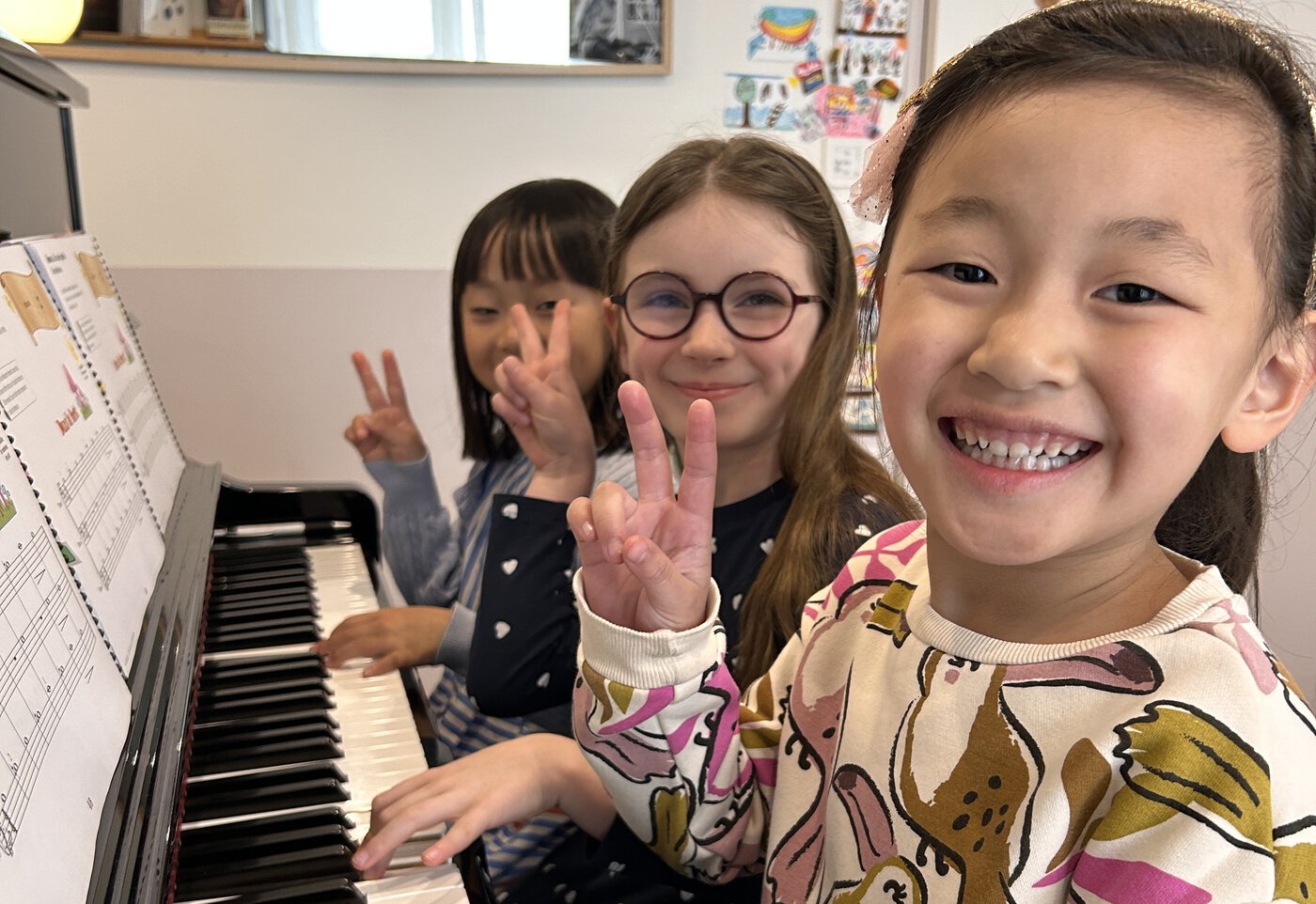
The piano holds a unique place in music education. Highly sought after by families, it is most often taught in a one-on-one setting: one teacher, one student, one piano. This model has obvious merits, but it led me to wonder what a truly collaborative experience might offer right from the very first lessons. What would happen if several young pianists discovered the instrument together—not each at their own keyboard, but by sharing the same piano? It was from this reflection thatA Piano for Three : Three beginner children—one in the low register, one in the middle register, and one in the high register—learn together while each maintains their own musical space and responsibility. How do three students learn together? To begin with, I form groups of three children who are complete beginners and of similar age, generally seven years old and up. This means they all start learning the instrument from the same starting point.
A session might introduce, for example, a new note and a new rhythm. First, we read the instructions and the sheet music together; then the children say the notes in time with the rhythm to get a feel for the beat before playing. They then move to the keyboard—each in their own range—while continuing to name the notes. At first, many pieces are intentionally written in unison. This approach is reassuring and allows students to gradually grasp numerous musical concepts: reading music, finding the notes, coordinating their fingers, and maintaining the beat. Then polyphony is introduced: the parts become distinct, and each student must maintain their own melodic line while listening to their classmates’.
Learning by Watching and Listening
In a small group, students no longer learn solely from what the teacher says. They observe, hear a rhythm before playing it, pick up on a movement, and sometimes notice a classmate’s mistake. A child who has just grasped a concept can also rephrase an instruction for another student. Helping others then becomes a way of learning. Above all, playing together introduces a very concrete sense of responsibility: my part matters to the others. If I lose the beat, miss my cue, or stop playing, the whole group immediately feels the consequences. Listening, waiting, reacting, and holding one’s part become essential for the music to come to life.
However, the goal is not to make the student dependent on the group. In fact, it’s quite the opposite. Progress is conceived as a journey: first playing the same thing together, then playing different parts together, and finally playing alone. In A Piano for Three, concepts are first explored as a group. Gradually, individual sections—marked by little fireflies—allow each child to apply what they’ve just learned on their own. A little house icon indicates the work to be continued at home. At the end of the first four chapters, games also serve as brief assessments to ensure that the theoretical concepts have been mastered before moving on. The group setting thus becomes a space where children discover and build knowledge together, before each child individually internalizes what has been learned.
An Idea for Music Schools
This experience ultimately raises an institutional question. Many music schools and conservatories face high demand for piano lessons, while the number of available spots remains limited. Why not consider, for some beginners, a group introductory course before they enter the traditional curriculum? Whereas one hour might accommodate two students individually, for example, two successive groups of three could allow six children to discover the instrument, gain their first points of reference, and begin to develop their independence. The benefit would not be merely quantitative. Such a period would allow children to confirm their interest in the piano, discover the joy of playing with others, and gradually adapt to the demands of learning an instrument. For families, the school would no longer simply respond, «There’s no room,» but could instead offer a structured introductory experience.
Collaborative learning will not necessarily replace one-on-one instruction. But between one-on-one lessons and waiting lists, there may be a space that has not yet been fully explored. Group learning could become not only a teaching tool, but also one of the gateways to music school.
Caroline Fauchet is a concert pianist, piano teacher, composer, and author of *Un Piano pour Trois*.