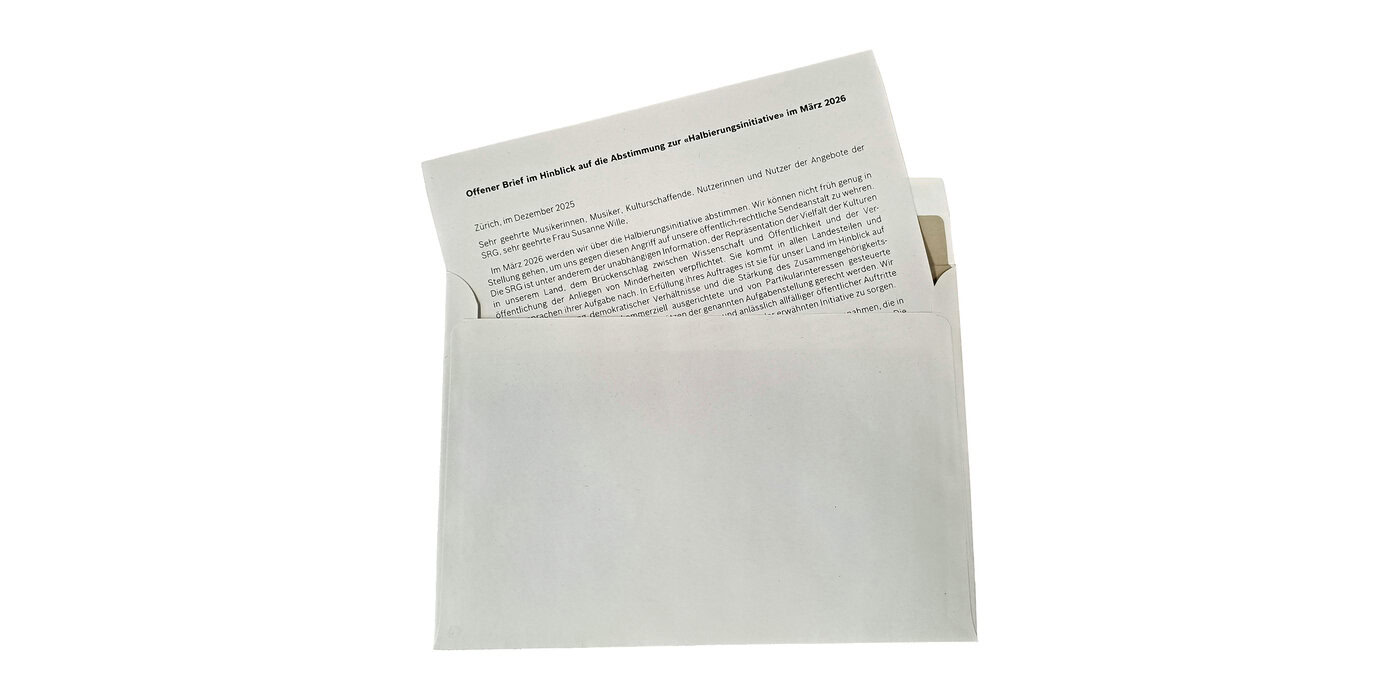

Open letter concerning the vote on the "200 francs is enough" initiative in March 2026
130 people, mainly from the music industry, have signed an open letter concerning the vote on the
the "200 francs is enough" initiative in March 2026.




Zurich, December 2025
Dear musicians, cultural creators and users of SRG programming,
dear Mrs Susanne Wille,
In March 2026, we will be voting on the "200 francs is enough" initiative. From the outset, we are taking a stand against this attack on our public broadcasting service. SRG is committed to providing independent information, representing the cultural diversity of our country, building bridges between science and the general public, and publicizing the concerns of minorities. It fulfils its mission in all regions and languages of the country. In fulfilling this mission, it is indispensable to our country in maintaining democracy and strengthening the sense of belonging. No private, commercial channel driven by vested interests can fulfil these tasks, even in part. We are called upon to show our solidarity with the SRG in discussions and public appearances over the coming months, and to ensure that the above-mentioned initiative is rejected.
This obligation is binding. However, we must protest in the strongest possible terms against the measures decided by the SRG management in recent months. The right-wing populists' strategy of undermining democratic conditions includes attacks on independent media and the freedom of science and the arts. The abolition of programs, for example in the fields of literature and science and, more recently, in the field of music - "Musik unserer Zeit" in German-speaking Switzerland - is a premature concession to the above-mentioned right-wing tendencies and an abandonment of the central points enshrined in the public service remit.
The major Swiss cultural associations have so far refrained from taking a public stance on these cuts, probably in order not to weaken the referendum campaign against the initiative to halve SRG funding by criticizing the latter. However, in view of the current situation and future developments, it is necessary to make a firm commitment to maintaining sufficient funding for the SRG, and to criticize the decisions taken by its management. SRG deserves our support because of its unique characteristics. Its current strategy of adapting to market demands is tantamount to ignoring the mission that justifies adequate public funding. Instead of cutting programs such as "Wissenschaftsmagazin" and "Musik unserer Zeit", the management's strategy in the referendum campaign should, for example, be to resolutely pursue the dialogue between science and society, and to meticulously nurture in-depth journalistic work in the cultural sector.
Market researchers may consider listeners of Espace2's music and literary columns to be negligible, just like the die-hard fans of "Klassiktelefon" or the loyal audience of "Echo der Zeit" - to stay within the realm of radio programs. In the run-up to the next vote, we must not forget that this loyal audience is ready to mobilize in defense of SRG.
SRG must rely on resistance rather than adaptation, on its uniqueness, if it is not to dig its own grave. It urgently needs to remember which key areas of its mission it needs to protect, and who its comrades and allies in civil society are in the fight against the initiative to halve its budget.
Signatories (in alphabetical order)
Heinrich Aerni, Ingrid Alexandre, Dieter Ammann
Ulrike Andersen, Monika Baer, Nik Bärtsch
Werner Bärtschi, André Baltensperger, Philip Bartels
Felix Baumann, Peter Baur, André Bellmont
Elisabeth Berger, Marino Bernasconi, Ramon Bischoff
William Blank, Dominik Blum, Bettina Boller
Hugo Bollschweiler, Thüring Bräm, Esther de Bros
Albin Brun, Catriona Bühler, Christiane Bult
Peggy Chew, Jessie Cox, Flurin Cuonz
Reto Cuonz, Therese Cuonz-Räz, Jürg Dähler
Claudio Danuser, Daniela Dolci, Mariana Doughty
Alfred Felder, Adrian Frey, Daniel Fueter
Thomas Gartmann, Bettina Ginsberg, Roger Girod
Katharina Gohl, Anna-Katharina Graf, Kathrin Graf
Ivo Haag, Jonas C. Haefeli, Viviane Hasler
Edu Haubensak, Doris Hauser, Fritz Hauser
Ruedi Häusermann, Hanna Helfenstein, Horst Hildebrandt
Christian Hilz, Jeannine Hirzel, Beat Hofstetter
Christoph Homberger, Raphael Immoos, Markus Jans
Mischa Kaeser, Eriko Kagawa, Vera Kappeler
Christoph Keller, Max E. Keller, Simone Keller
Burkhard Kinzler, Michael Kleiser, Christian Kobi
Canan Kocaay, Tamriko Kordzaia, Niklaus Kost
Herbert Kramis, Hanspeter Kriesi, Anne-May Krüger
Jojo Kunz, Annette Labusch, Matías Lanz
Leslie Leon, Heinrich Mätzener, Delia Mayer
Thomas Meyer, Roland Moser, Moritz Müllenbach
Marie-Louise Müller Choquard, Martin Neukom, Lucas Niggli
Anne-Catherine de Perrot, Stefka Perifanova, Peter Reidemeister
Felix Renggli, Nicola Romanò, Petra Ronner
Michel Roth, Johannes Rühl, Bettina Ruf
Edward Rushton, Nina Sahdeva, Claudine Saner
Urs Saner, Evangelos Sarafianos, Tobias Schabenberger
Sir András Schiff, Isabelle Schnöller, Oliver Schnyder
Muriel Schwarz, Meinrad Schweizer, Yuuko Shiokawa
Peter Siegwart, Rahel Sohn, Peter R. Solomon
Bruno Spoerri, Eleonor Stähli, Jacques Stähli
Urs Stäuble, Egidius Streiff, Monica Thommy
Germán Toro Pérez, Balz Trümpy, Saadet Türköz
Nina Ulli, Christoph Ullmann, Petra Vahle
Katharina Weber, Urs Weibel, Andreas Werner
Peter Wettstein, Maki Wiederkehr, Helena Winkelmann
René Wohlhauser, Maria Wolff, Alfred Zimmerlin, Samuel Zünd
PDF download of the original letter