
Pierre Boulez - an unbreakable bond with Switzerland
The year 2025 marks the centenary of Pierre Boulez's birth, and celebrates the work and thought of the French composer, conductor, theorist and teacher through a series of events. An opportunity to reflect on the legacy of this major avant-garde figure.




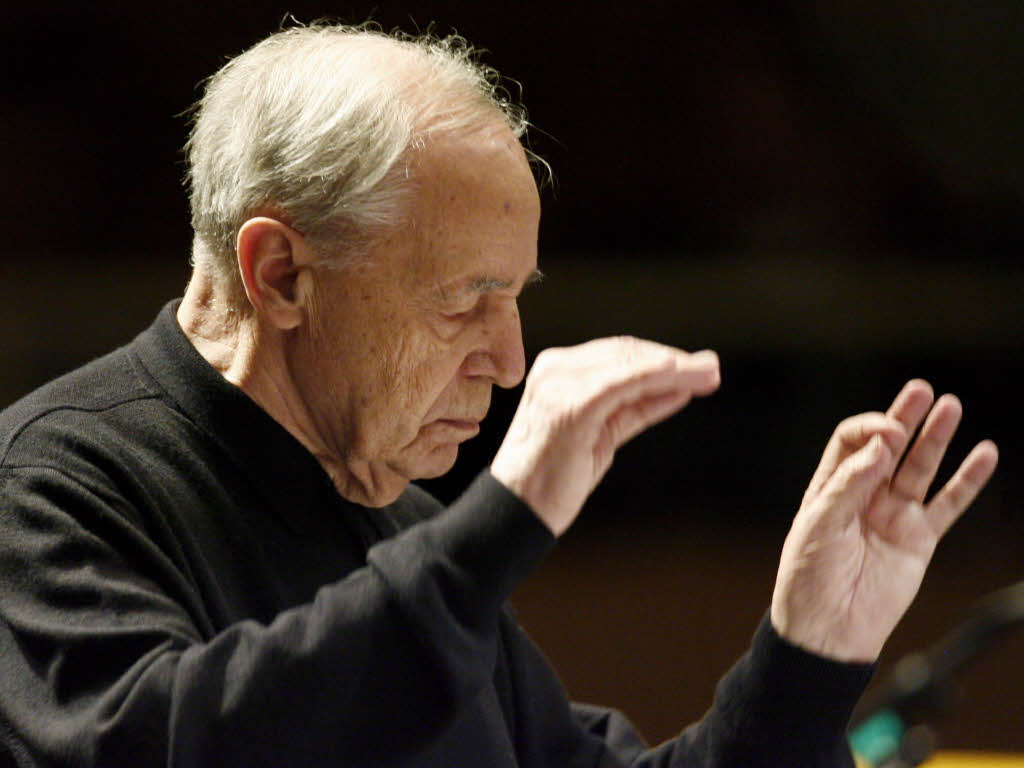
Photo : DR
Pierre-Michel Menger, sociologist and professor at the Collège de France (Sociologie du travail créateur chair), and Nicolas Donin, musicologist and professor at the University of Geneva, tackle the question in a cross-examination.
Pierre Boulez has had a strong influence on the development of contemporary creation and the evolution of cultural institutions in France and internationally. What impact did he have on the Swiss musical landscape?
Nicolas Donin : Boulez's impact is multi-faceted. On a global level, one might say, Boulez's role model and his programming style, the works he brought to the fore, and the way these works were performed. It's a model that has had a plural impact, in different ways and in different places. Including in Switzerland, of course, particularly in certain towns or cantons, either because cultural life there was more specifically geared towards avant-garde music, or because there were people who were able, in a way, to extend and concretize Boulez's ideas in certain places.
You're referring to Basel, Geneva and Lucerne first and foremost...
Pierre-Michel Menger: Boulez's archives are scattered all over the world, but Basel is home to by far the most extensive collection of Pierre Boulez's manuscripts, the aim of which is to give researchers access to this corpus of the creator's work, which spans the period from 1990 to 2016.
N.D.: In Basel, of course, was Paul Sacher, the patron of the arts whose loyal friendship bound him to Pierre Boulez, and who strongly encouraged and supported Boulez's work both as a composer and as a conductor. It was Sacher who first invited Boulez to give composition and conducting lessons in Basel. It was also Paul Sacher who took care, when founding his archival institute, the Paul Sacher Foundation, to bring Boulez's sketches and working documents together in one place, thus considerably facilitating research into the composer. It should be added that Paul Sacher was also a patron of the IRCAM (Institut de recherche et coordination acoustique/musique), conceived by Boulez, to which he regularly donated a substantial sum throughout the years of the institute's creation and start-up in the 70s and 80s. In Basel, therefore, Boulez and his music were a regular presence and a kind of relay of influences.
And in this relay of influences, there is above all the composer Heinz Holliger...
N.D.: Indeed, Heinz Holliger, who also lived in Basel, became one of the leading figures of avant-garde music in Switzerland. In the early 60s, he was briefly one of the students in Boulez's composition class, whose approach made a strong impression on him and to whom he also became close. Then, at the turn of the 70s, Holliger distanced himself from Boulez's aesthetic approaches. This did not prevent the two musicians from coexisting in a very rich way. It's obvious that Heinz Holliger retained from Pierre Boulez a certain kind of rigor in his writing and a fairly clear-cut character in his aesthetic choices, as opposed to a form of post-tonal reaction. This is something that all the musicians who were close to Boulez, whether in Switzerland or elsewhere, have in common.
In fact, IRCAM has contributed to strengthening the role of composers and creation...
P.-M.M.: Boulez was a fervent advocate of creation. And since the founding of IRCAM, important computer discoveries have been made, enabling the emergence of a new musical language based on electronics. This development has led to the creation of other centers in Europe, such as those in Italy and Switzerland. In 2005, for example, the Institute for Computer Music and Sound Technology was established at the Zurich University of the Arts.
In Geneva, Editions Contrechamps aims to promote the music of the 20e and 21e centuries through essential writings...
N.D.: Editions Contrechamps and above all the Ensemble Contrechamps, founded by musicologist Philippe Albèra and specializing in the creation and dissemination of this music. In fact, Contrechamps began as a project for a venue, an ensemble and a magazine. Later, it stabilized around two poles: first, the magazine, conceived in 1983, which became the Editions in 1991. They have contributed to the knowledge of the musical thought of Boulez and many other composers. Then there's the Ensemble, which continues to exist to this day. In Switzerland, the Ensemble Contrechamps remains the most developed and best-funded ensemble. The Ensemble was originally created to perform avant-garde music, but not only. Nevertheless, Pierre Boulez can be considered a key figure for this ensemble. Philippe Albèra himself identified Boulez and Berio as major intellectual and aesthetic figures of the second half of the 20th century.e century.
Pierre Boulez also leaves a significant mark on Lucerne through his training of young musicians...
N.D.: Yes, in 2003 Pierre Boulez and Michael Haefliger founded a music academy within the Lucerne Festival, of which he was also artistic director until 2015. Each year, he will teach talented young musicians from all over the world. In a way, this academy was the last institution created by Boulez... It introduces musicians to the repertoire of the 20th century.e and 21e The Académie du Festival is a place where young composers are welcomed and where young conductors can conduct contemporary ensembles, first in conducting workshops and then in public concerts. When Wolfgang Rihm succeeded Pierre Boulez as director of the Festival Academy in 2016, he introduced the Composers' Seminar, a way of extending his vision... Today, we meet many musicians in their thirties and forties who have been through the Lucerne Orchestra Academy and talk about the precious experience of having been conducted by Boulez.
With regard to the creation and distribution of music from the 20e and 21e centuries, what is the current state of play and what is the interest in contemporary creation today?
P.-M.M.: The system for creating the specialized contemporary music circuit has been around for decades. It has taken off since the 70s, roughly speaking. Everything that was donated to the Ensemble Intercontemporain and IRCAM prompted and legitimized an increase in resources for other ensembles as counterpoint and compensation. And all this has continued to operate with varying degrees of visibility. I'm not sure that contemporary music today is as important a cultural issue as it was in the 70s, 80s and 90s. This is a matter of personality. Boulez's personality was considerable, playing the role of a magnet, capable of attracting the public's attention and transforming issues into matters of general cultural interest. Today, when you look at the press, there are very few mentions of contemporary music concerts. Contemporary music has splintered off in many different post-modernist directions. And so the system works, the resources are there, the radio stations program contemporary music festivals. Perhaps there's less excitement around contemporary music festivals than there used to be... But there's a kind of comfort in a system that's established, that hasn't been damaged by the considerable drop in resources, but that hasn't given rise to any new impetus either. In other words, it's set up, and it works: commissions, ensembles, festivals and specialized radio broadcasts all exist. But then, for these works to enter the wider circuit of symphonic broadcasting, etc., it's almost become an obligatory pattern. Another element is that women have been given greater importance in musical life, and opportunities to occupy compositional and conducting positions are now open to them, fortunately.
A few years ago, the institutional project to create a Cité de la musique in Geneva failed to come to fruition. In your opinion, is the current socio-economic and political environment in Switzerland conducive to innovative reforms that could transform the entire Swiss musical landscape?
N.D.: Here, the difference between our two democracies is, in my opinion, very clear. The Geneva music project was put to the vote, and the people decided. Whereas the Cité de la Musique project in France, in the 90s, was not subject to any democratic control apart from the election of government teams, some of whose members were in favor or against the project. The logic is therefore different. It's interesting to note here that Laurent Bayle, the general curator of this commemoration of Pierre Boulez, insisted, in his speech at the Collège de France, that Boulez had been very strong in his museum-inspired vision - a multipolar and multifaceted side to an institutional project for music. He really made sure that there was, at almost equal strength, a heritage element in the museum, a pedagogical element in hosting classes, and a publishing and distribution element, around a concert hall project with its programming. This idea was not at all embodied in the Cité de la Musique project in Geneva. That's another difference, but I'm not saying it explains the project's success or failure. What we can say with certainty about Boulez's impact is that anything that goes in the direction of these multi-departmental institutions with long-term support, whether from the State or any other entity, is an idea that Boulez really brought to bear with force and made concrete.
Ensemble Intercontemporain violinist Hae-Sun Kang laments the fact that Boulez's works have been performed very little over the last twenty years, with the exception of this "Boulez year". How do you explain this trend, even though these works are accessible to performers?
P.-M.M.: There are cycle effects. Firstly, Boulez's body of work is not gigantic, and he has been played extensively by the Ensemble Intercontemporain. It's possible that at some point, those in charge of programming may have felt the need to alter the balance of concert programs. Then, the death of a composer always has a "boom" effect. Part of his work is less visible, and then there's a re-qualification of his work. Then it starts up again, and the work is rediscovered... It's classic. These are well-known phenomena. The philosopher Jacques Derrida once said to me: "Five minutes after my death, 95 % of my work will be dust". This is not the case with Boulez... Secondly, I think that one of the ways in which a work can live and have lasting value is to be questioned, not to exist by itself. It's to be questioned by the problems posed to it. If the younger generations feel that there is something in Boulez that needs to be taken up again, then a kind of climate of renewed attention and renewed questioning will be created, even if it may be conflictual, likely to arouse a desire to confront opposing directions and experiment. This is a good way of bringing works to life: subjecting them to a bombardment of questioning. Otherwise, it's all over. Posing a problem and asking questions of the works brings them to life! But there must also be people who play a role around the work, i.e. who are committed to bringing it to life, such as conductors, performers, artistic directors...