
The destinies of 20th-century composers
Portraits of recently published composers: a monograph devoted to the forgotten Swiss musician Robert Oboussier, complemented by a record release, the first French-language biographies of Hans Werner Henze and Carl Orff, plus interviews with Igor Stravinsky and contemporary Philippe Hersant.




Robert Oboussier
Robert Oboussier (1900-1957) was an important figure in Swiss musical life, a recognized composer played by famous performers, a renowned music critic and vice-director of Suisa. He was suddenly excluded from the collective memory, his works banned, deprogrammed from concerts and banned from publishing catalogs, his documents, letters, photographs and private memorabilia mostly destroyed. The reason? His murder by a young prostitute who had publicly revealed his homosexuality. A political and media storm ensued, reversing the roles of victim and executioner and ushering in a period of increased repression against sexual minorities in the prudish Zurich of the time, a climate of hatred involving dismissals, termination of leases and systematic police record-keeping. It's only recently that Oboussier's compositions are finally coming out of oblivion and silence, in particular on the occasion of the 125e anniversary of his birth, and thanks to the efforts of young Bernese composer and sound engineer Ramon Bischoff, who has brought out a book featuring short essays and reproductions of documents. Entirely bilingual, this tribute to an ostracized composer whose archives have largely disappeared, making it impossible to write a truly detailed biography, contains seven contributions, including that of a witness to the period, the activist Ernst Ostertag, an analysis of the piano pieces by Tomas Bächli and a description by Bruno Rauch of the city on the banks of the Limmat in the post-war years, as well as a repertoire of surviving works.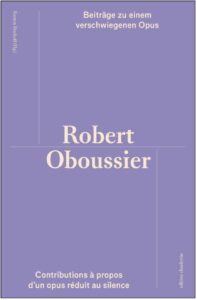
Robert Oboussier. Contributions à propos d'un opus réduit au silence/Beiträge zu einem verschwiegenen Opus, ed. by Ramon Bischoff, 208 p., Fr. 45.00, edition clandestin, Biel 2025, ISBN 978-3-907262-72-6
Recording of works by Robert Oboussier
At the same time, a CD released by the Musiques suisses label features several of Oboussier's previously unrecorded compositions - it's true that his discography remains very thin, even if some early recordings have recently been released (the dramatic and moving cantata Antigone or the violin concerto). Tomas Bächli is back, this time performing the complete surviving piano works, namely a Fantasy from 1948, dedicated to the great performer Géza Anda, which varies a dodecaphonic theme, and the astonishing cycle of the 25 abbreviations (1938), miniatures lasting an average of just 30 seconds (half that for the shortest and 50 seconds for the longest), unfinished and dense gestures, giving the impression of a thematic index and leaving us to imagine how each piece might continue. Some of these fragments are also presented in a version arranged by Christian Wernicke for mandolin ensemble. Chamber music is represented by the neoclassical Sonata brevis for violin and piano, an early work that features three short movements, including a central fugue, by the gentle and very sensitive Sonatine for two violins and piano, which shows the influence of French music, as does the graceful diptych Pavane and Gaillarde for flute and piano, commissioned by the 1948 Geneva International Music Performance Competition (whose first prizewinner was Aurèle Nicolet), in which a sensual, sinuous melody alternates with a more deliberate movement. Another commission from the Geneva competition, the jovial Entrada from 1943, intended for aspiring trumpet players, requires formidable leaps of register in the expressive middle section. More interesting is the’Introitus composed two years later for string orchestra, commissioned by Paul Sacher for his Collegium Musicum in Zurich, mixes, as is often the case with Oboussier, atonality and tonal elements, thematic re-expositions and free variations, chordal successions and polyphonic passages. The various performers on this disc defend these works with conviction, happily bringing this repertoire out of oblivion, while awaiting, we hope, other recordings (his postromantic Trauermusik for orchestra or his lieder, for example).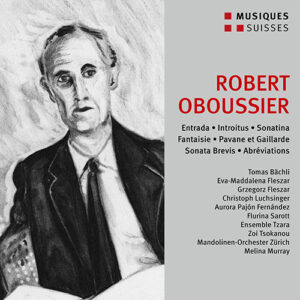
Robert Oboussier: Entrada, Introitus, Sonatina for 2 Violins and Piano, Fantasie, Pavane et Gaillarde, Sonata brevis, 25 abréviations. Naxos Musiques Suisses NXMS7008
Hans Werner Henze
To avoid being sent to a concentration camp, composer Hans Werner Henze (1926-2012) also had to hide his homosexuality, but he found that, with the dreadful Nazi regime gone, conservatism and intolerance had not left Germany. In order to rediscover his inner truth and freedom, he went into exile in Italy, a country which, along with Greece, brought him clarity and melodic flexibility, tempering the German expressionism of his early works. This enabled him to distance himself from the doctrinaire musical avant-garde of his homeland, in order to serve his own conception of aesthetic beauty and to emancipate himself from the pressures that prevented stylistic openness. Claiming the dual heritage of Schoenberg (and his disciple Berg, rather than Webern) and Stravinsky, he amalgamated numerous contributions, from Baroque music to jazz, from 19th-century Italian opera to his own.e The result was an abundant, protean body of work, including the many operas and ballets that have established his international reputation. His musical thinking was strongly influenced by his social and political commitment (partly disillusioned when he realized that the atmosphere in Communist countries resembled that which he had experienced in the Germany of his youth, where there was constant fear of denunciation and rejection of anything that might be considered deviant). In this first French-language biography, supplemented by a catalog of works and an extensive bibliographic and discographic selection, Philippe Torrens' lively pen chronologically relates Henze's life and artistic and intellectual evolution, in the hope that his compositions will be better appreciated in French-speaking lands, where they remain largely unknown.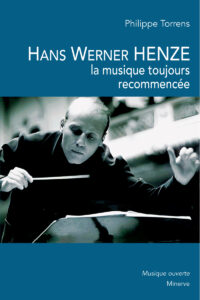
Philippe Torrens: Hans Werner Henze. La musique toujours recommencée, 252 p., € 24.00, Éditions Minerve, Paris 2025, ISBN 978-2-86931-187-9
Philippe Hersant
As attracted to Italy as Henze was, Philippe Hersant, one of France's most-performed contemporary composers, was born in 1948 in Rome, where he spent his childhood. In a book of interviews with writer Jean-Louis Tallon, this engaging, cultivated humanist confides in us about some of the key moments in his life, his passions and interests, the genesis and development of his major scores, and the process involved in the compositional act. From the Middle Ages to the present day, with a predilection for Baroque music, his sources of inspiration are manifold, and include musical traditions from countries all over the world - sound images whose memory resurfaces at the origin of many of his pieces, but also writing processes or materials borrowed and integrated not with the aim of creating a pastiche, but with the desire to appropriate them and arrange them in a personal way, to present them in a new way, creating an amalgam rather than a collage. Fascinated by the blending of styles, he believes that emotion can arise from the serene or tragic confrontation between two eras, from their harmonious or dissonant interaction. To achieve this freedom, he had to free himself from the self-censorship imposed by the prohibitions of the currents that still dominated contemporary music at the end of the 20th century.e century, and agreed to follow his own path, which was the only way out if he wanted to continue composing. His richly diverse catalog covers all genres, including film music and opera (the first of which, Carpathian Castle after Jules Verne, was a major contributor to its success). The voice plays an important role in this work, with a wide range of texts, from Greek antiquity to the present day, from Judeo-Spanish folk songs to poems by inmates of the Clairvaux prison, via Dante, Hölderlin, Segalen and Garcia Lorca, while his research into timbre regularly leads him to use ancient instruments, in particular the viola da gamba.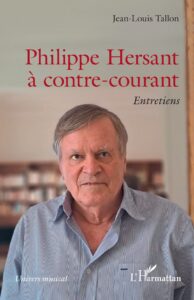
Jean-Louis Tallon: Philippe Hersant à contre-courant, interviews, 246 p., € 25.00, Éditions L'Harmattan, Paris 2025, ISBN 978-2-336-57275-8
Carl Orff
As much as Henze involved himself in society, Carl Orff (1895-1982) remained indifferent to everything that wasn't himself and his own creations - even his four wives and daughter took a back seat. Initially fascinated by Richard Strauss and Debussy, he rejected their influence and set out in search of «elemental music», which he discovered in contemporary dance, liberating the body. Fascinated by ancient classicism, close to the pictorial, choreographic and theatrical avant-garde (he collaborated with Brecht, among others), he discovered Baroque music (especially Monteverdi) and music from the Far East, particularly Indonesia, which helped him define his own style, also containing elements of the folk music of his native Bavaria, to which he was very attached. In his forties, Orff enthusiastically set to music medieval poems, giving the Carmina Burana, without which he would probably be less well known as a composer than as the inventor of an important teaching method. Still present in over thirty countries, using a specific instrumentarium, his Schulwerk focuses more on the learning process itself than on pre-established results. Music critic and columnist Jean-Philippe Thiellay, author of several books on opera composers, most recently Meyerbeer, has written the first French-language biography of Orff, in which he also highlights the ambiguities of the figure, His fame grew under the Nazi regime, he compromised himself out of opportunism - although, according to this biographer, he kept a certain distance, adhering neither to the party nor to its ideology - and, after the war, he ingeniously self-justified his more than equivocal conduct. The final part of this monograph takes stock of recent debates on the subject.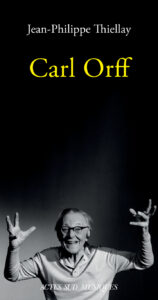
Jean-Philippe Thiellay: Carl Orff, 240 p., € 20.00, Actes Sud, Arles 2026, ISBN 978-2-330-21606-1
Igor Stravinsky
Published in 1960, the second of six volumes of interviews between Igor Stravinsky and his close collaborator during the last period of his life, the conductor Robert Craft, provides anecdotes and considerations, musical and otherwise, reproduces a number of messages and letters, and paints vivid, sometimes uncompromising pictures of people whom the author of Le Monde had never met. The Rite of Spring The first part deals with his family, youth and training in tsarist Russia. The first part evokes his family, his youth and training in tsarist Russia, as well as some of his compatriots, dancers or choreographers with the Ballets Russes, including Nijinsky, or composers, such as his master Rimsky-Korsakov, Prokofiev or Scriabin (whose music he obviously didn't appreciate at all). A few portraits, from Paul Valéry to Reynaldo Hahn, form a sort of transition before the more strictly musical part, in which he discusses Renaissance chromaticism, from Willaert to Gesualdo, as well as Gruppen of Stockhausen or the interpretation of Viennese classics, is enthusiastic about Josquin or Webern, distributes a few scathing jabs (calling Carl Orff's works neo-Neanderthal, for example), deals with electronic music or that composed for the cinema. He also recounts how he came to have to share part of his royalties on Petrouchka, The last quarter of the book deals with three of his operas, mainly from the point of view of his relationships with the librettists. Not always indulgent, sometimes contradictory, but always interesting, Stravinsky opens up with a rare transparency and without false modesty. The pleasure of reading is enhanced by the pleasant, airy layout, the choice of an attractive font and abundant illustrations, all hallmarks of Editions Allia, who had already published the translation of the first volume of these interviews in 2024.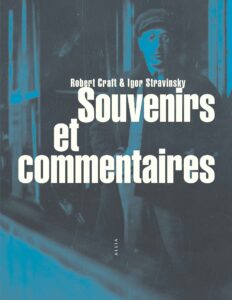
Robert Craft & Igor Stravinsky : Souvenirs et commentaires, 224 p., € 19.00, Éditions Allia, Paris 2026, ISBN 979-10-304-3116-2