
Instruments and musical practice
Recent publications focus on musical vocabulary and expressions, electric guitar techniques, non-European musical instruments and the political dimension of improvised music.




As a study of proper nouns, onomastics can be a fascinating subject, especially when presented in the lively style of linguist Stéphane Gendron, who multiplies anecdotes and quotations, reconstructs etymologies without any pedantry and, above all, wittily reveals the wealth of vocabulary and expressions specific to music and musicians, while placing them in their historical and sociological context. Whether we're talking about borrowings from everyday language to signify musical facts or, conversely, the use of musical terms to name other, sometimes very trivial realities, whether time-honored formulas, elements of performers« own jargon or locutions from old or more recent slang, the terminological palette is as wide as the semantic devices are varied. Indeed, the playful creativity of language makes virtuoso use of metaphor and metonymy, as well as abbreviations and suffixations. Divided into two parts, the book deals successively with expressions devoted to different instruments, from the piano to the harmonica and from the violin to the xylophone, and with musical practice, techniques and modes of playing. Unlike a dictionary, which would separate each entry, we are invited to take a pleasant tour, naturally discovering statements such as »macaroni voice« or »having a grasshopper in your guitar«, looking for analogies, for example of animal origin, or catachrases such as »violin« for prison or »jambonneau" for mandolin.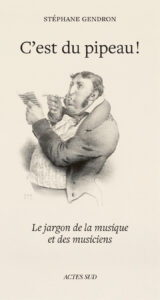
Stéphane Gendron: C'est du pipeau! Le jargon de la musique et des musiciens, 216 p., € 20.00, Actes Sud, Arles 2025, ISBN 978-2-330-20908-7
At a time when small ensembles of musicians accompanying ballroom dances were mainly limited to a few bowed string instruments, the guitar could easily join in; but when the fuller sounds of the saxophone or trumpet were added, not to mention the progressively omnipresent drums, the imbalance put it at a considerable disadvantage. After initial attempts at amplification in the early 20e century, it wasn't until the late 1940s that technological developments produced conclusive results. However, the timbre was no longer that of the «acoustic» guitar, and musicians soon realized the advantages offered by the new instrument (extended sounds, string effects, changes in tone depending on pickup placement...), while luthiers added useful additions (various types of sensors, tuning knobs, effects pedals). Enthusiastically embraced by a variety of musical styles, the electric guitar has long been little appreciated in contemporary classical music, even though the likes of Martin, Murail and Penderecki have used it in some of their works. However, over the past fifteen years or so, it has aroused the interest of a growing number of composers. Following on from the book dedicated to the acoustic guitar, published in 2014 in the same collection, this new tome describes in detail how the electric guitar works, its many possibilities, and its usual and special techniques. Several members of the family are also presented: the bass, of course, but also the lap steel, played flat on the knees, the quarter-tone version and many others less commonly used. The book, written in English, also includes numerous musical examples and interesting contributions from outside authors, such as composer Richard Barrett's thoughts on how to include this instrument in a symphony orchestra.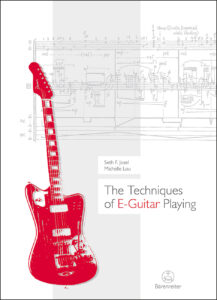
Seth F. Josel / Michelle Lou: The Techniques of E-Guitar Playing, 303 p., € 69.00, Bärenreiter, Kassel 2025, ISBN 978-3-7618-2424-5
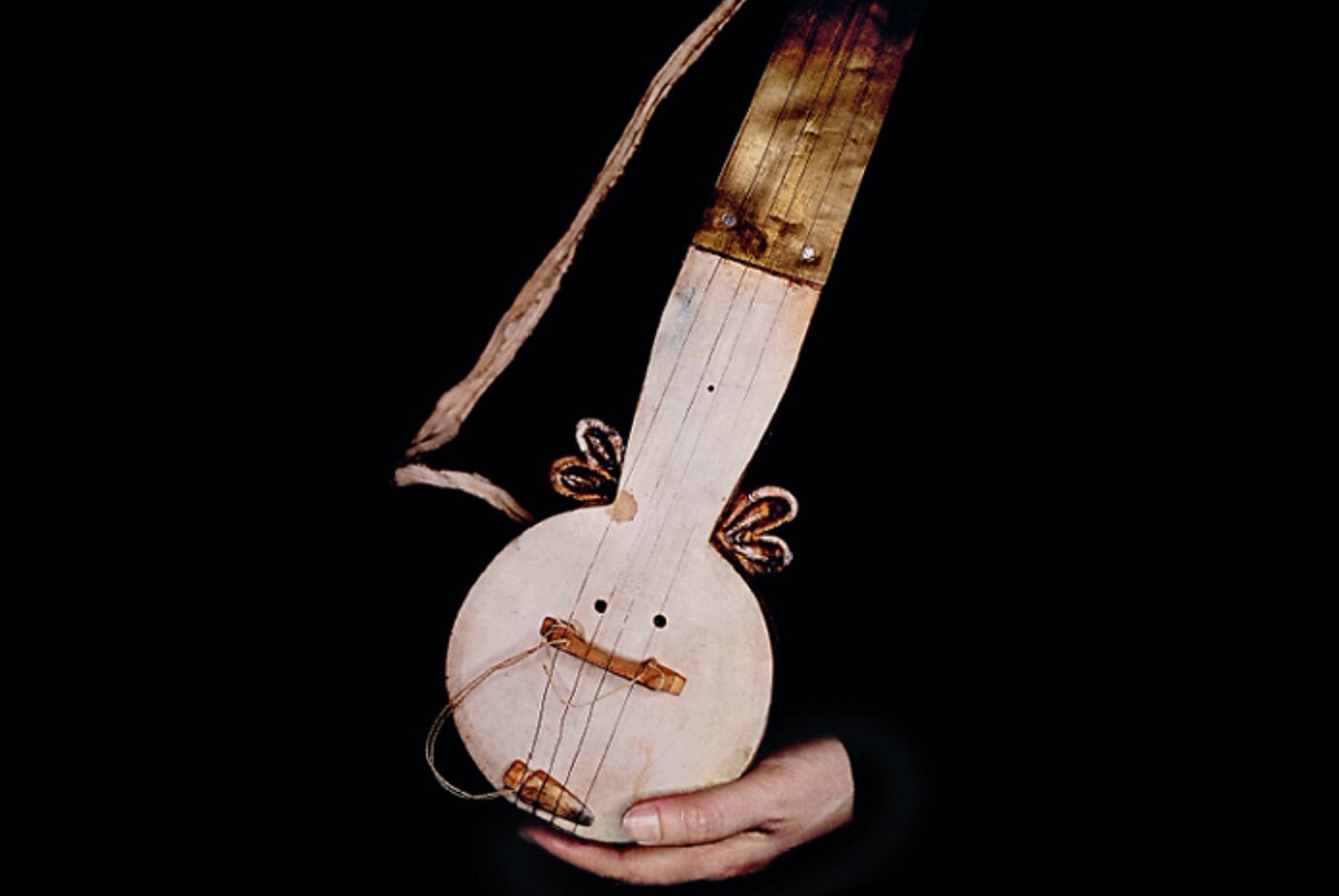
Inaugurated in 2006, the Musée des Arts et Civilisations d'Afrique, d'Asie, d'Océanie et des Amériques took on the name Musée du Quai Branly - Jacques-Chirac ten years later, in tribute to the former president who helped create this flagship Parisian museum, famous as much for its collection of primitive arts, one of the largest in the world, as for its architecture by Jean Nouvel. Among the artifacts housed here are some 10,000 musical instruments (around 3,850 from Africa, 2,600 from Asia, 2,450 from America - including 900 pre-Hispanic pieces - 600 from Oceania and 500 from India), displayed in a 16-meter-diameter internal tower, visible through glass walls on all six levels of the building - a literally spectacular arrangement. Recently, the museum published a beautiful album highlighting a selection of 81 of these instruments, from 45 non-European countries, thanks to exceptional-quality reproductions, often full-page, mostly by renowned photographer Richard Dumas. Classified by theme (instruments as carriers of messages or rituals, as toys or historical witnesses, the sacred dimension of breath, know-how and materials used, human or animal figurations), this selection focuses not only on the intrinsic beauty of each instrument, but also on their representativeness and diversity. Their description, perfectly accessible to non-experts, helps to decipher their origins, the circumstances of their manufacture and use, their symbolism, their social or supernatural links. Further insights are provided by testimonials from musicians, ethnomusicologists and historians from various parts of the world, as well as by a cultural activist from Argentina and a divination master from Benin.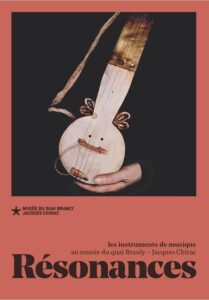
Résonances : Les instruments de musique au musée du quai Branly - Jacques Chirac, edited by Madeleine Leclair, 160 p., 14.90, Musée du quai Branly - Jacques Chirac, Paris 2025, ISBN 978-2-35744-168-2
Zurich-based Franco-Japanese violist Frantz Loriot spoke with well-known Franco-Swiss saxophonist and composer Bertrand Denzler about the links between improvisation, which they both practice masterfully, and its political dimension, with particular reference to the thoughts that have influenced the former, These include the French geographer and anarchist Elisée Reclus, long exiled on the Vaud Riviera, the anti-capitalist economist and philosopher Frédéric Lordon, who criticizes libertarianism, and the West Indian novelist Edouard Glissant, who questions, among other things, intercultural relations in perpetual motion. Playing music without hierarchical organization, without codified aesthetics and outside recognized institutions not only leads to decisions and new responsibilities, but also raises a host of questions, for example about the relationship between the individual and the collective, the space for freedom and equality among musicians. A renewed awareness of the exercise of a creative act can transform thinking and be reflected in the socio-political positioning of artists. In order not to fall back into a normative order, but to remain open to the unexpected, improvisers must be able to constantly question their own language in the light of the ideal of free improvisation (or, to use Bertrand Denzler's term, «non-idiomatic»). A true liberation that also enables us to identify the improvisational element in formally written music. Rich in reflections, this opuscule touches on many other themes, such as the delicate relationship with institutions, which don't operate according to the same criteria, or the analysis of processes underway during an improvisation session.
Bertrand Denzler / Frantz Loriot : Musique improvisée et questions politiques, Interview, 106 p., € 15.00, Éditions Bruit, Bienne 2025, ISBN 978-2-9701902-0-2